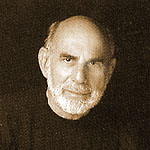
Ron Kent. Thin oil-soaked, uplifted vessels turned from Norfolk pine are immediately recognized as his and his alone (though imitators appeared). No one else has his minimalist/classical sense of form. The wood itself is an important part of the content. Norfolk pine is ubiquitous in the Pacific; legend has it that Captain Cooke saw to it that this very straight tree was planted everywhere to provide masts for sailing ships. Kent, like the sage wood pioneer Wharton Esherick, seems to believe that all the wood you need can be found in your own backyard. Norfolk pine local (on Hawaii where Kent lives), renewable, and for the asking. Kent has an eye for spalting and, since he lives in the tropics, he now deep-freezes roughly turned pieces to halt the configurations where he wants them to stay. But translucency is Kent's miraculous innovation. Properly lit, his bowls glow. He can control the light by the thickness and the thinness of the walls so that the turned bowl shapes light. Kent turns light. I have seen one piece that only glows near the base. Others glow as if radioactive. The shadow of one's hand can be seen through the wood.
John Perreault's Introduction to Turned Wood Now
- Arizona State University Art Museum 1997The Man Who turns Bowls into Gold
By Rose Stanek From Aloha Magazine 1987
He is a man of few words when you meet him socially and an admitted wallflower at social gatherings, but Ron Kent uses his wood-turning as an expressive outlet. His calabashes are "either the thinnest, large bowls or the largest, thin bowls" anyone ever made.
At one-tenth of an inch thick, they are translucent when held up to the light. His larger bowls measure up to almost thirty inches in diameter and as much as twenty-four inches deep. This golden amber, translucent piece was purchased by a private collector for $4,500.
Kent likes to work with all Hawaiian wood but his favorite clearly is Norfolk pine.
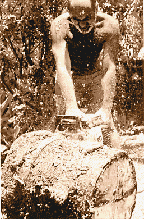
Kent begins work on another painstaking project. Photo by Doctor Milton Diamond
Since he never took a single woodworking lesson, Kent says he "never learned the 'right' way to do things... I sort of evolved a lot of unique ways of working, which nobody else does."
He started woodworking in college when it was the only way he could afford furniture. His craft soon developed to where he was making things better than he could buy.
"In 1972 years ago my wife bought me a lathe for Christmas" he recalls, "which is a disappointment to a furniture maker because there is not much you can do with it--posts, gavels, banisters, croquet sets. But I didn't want her to know I was disappointed, so I went down on the beach and got a piece of driftwood and made a thing that looked like a wooden whiskey bottle. And I was hooked!'
The following years saw Kent continuing to enjoy the shapes he made from whatever woods he happened upon. He was happy to discover the beauty he could bring forth from the wood.
Gradually, he says, his shapes got better and better. One day he looked at a bottle he had made fashioned like a genie's bottle and, examining it more closely, thought that if he worked with the flare of the neck, it might make an interesting bowl.
As delicate as his work is, Kent admits that he is a bit clumsy. He grew up in Hollywood, California. He jokes that the environment there may have been more of a hindrance than an asset to his later artistic achievements.
"I was the clumsy kid who was chosen last on the team," recalls Kent. "I was part of the package deal, 'We'll take John and you can have, Ron, Ken, Harry and Joe." So the kid in Hollywood had little of the artist in him.
Kent believes there's a definite distinction between artists and craftsmen, and he sees himself as more the former and as much of the latter as he needs to be.
"There are technicians, people who are really good at what they do. Think of music--there is a composer, director, the soloist and the first violin," Kent explains. "Each of them is a creative person but in a totally different kind of creativity. Maybe the first violinist is like the paid technicians--he does what he does perfectly--but there is little of him in it. The pure craftsperson is like the soloist. They do a good jobs of what they do, they are technically perfect and may embellish a bit on the composition somewhat with their own touch but they basically perform what someone else sat down and composed. (That somebody may not have been a good musician.)
"I think I am more like the composer, enough of a musician to be able to play my composition and show you what it looks like. I suppose I could be the technician if that were my goal. If you look at my things very, very closely you may see little scratches and tool marks, places that aren't totally finished in the modem craft sense of the word. But I know how to do it--I could spend the extra hour or two getting those out-but it isn't part of my game. I have lost interest by then. For me, forming the piece, seeing the beauty of the wood, putting my ideas into shape and seeing if I could do it--that is the challenge"
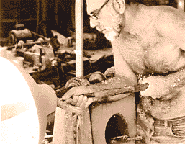
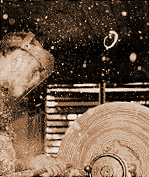
Kent uses his lathe for the majority of his woodcarvings. Photo by Doctor Milton Diamond
Kent's works have been highly acclaimed in exhibitions around the world. The American Craft Council Museum in New York City featured one of his pieces in their inaugural show last fall and the Smithsonian Institution has four of Kent's bowls in an exhibit touring throughout the United States. Early last year, Kent was asked to present a demonstration of woodturning at the Smithsonian. "I set up my lathe in the entrance of the gallery," Kent says. "I just went about my regular routine--took off my shirt, stripped to the waist in my cut-off blue jeans and started working. By the time I was finished I had a pile of sawdust about three feet high and people were tracking the mess all around the place. Everybody loved it!"
Kent's work has been selected for presentation as gifts to many business and governmental figures. One piece that was bought by the Hawaii State Senate for presentation to Hikaru Kamei, the governor of Fukuoka prefecture in Japan, was made "back in my bottle-making days," Kent says.
Although not one to work on commission, Kent has labored diligently on one particular piece for an upcoming presentation. "In the spring I have been scheduled for an audience with the Pope (John Paul)" Kent says, "not as part of a general audience, but after the general audience, I will present a special piece to him."
This fortunate opportunity started as the idea of a few local doctors who were touring Rome. They thought it would be a great idea to present one of Kent's pieces to the Pope. "They investigated the protocol and found out what would be an acceptable gift:' Kent says. "Just recently I got a letter from the Vatican arranging the audience."
The piece he has made especially for the Pope is chalice-shaped, thinly carved from Norfolk pine. Kent went through a half-dozen pieces before this met his standards of perfection. "Although it is finished I keep coming back to it," Kent says.
"I am just amazed at what a hobby has become. I don't believe I have a natural talent. And yet it has reached a stage where I have to recognize it. There is a book out and a lot of talk about what they call the ?imposter syndrome.? They have interviewed a lot of people like who are recognized as the top, but when you get right down to it they feel they are fooling everyone. I always feel that way. Every time one of my bowls gets into a show I get a feeling that if I could put it into words, it would be, 'Wow, I fooled another one. I fooled them again.' "
The relationship Kent has with his wife of thirty-six years, Myra, takes precedence even over his artistic endeavors. "That means sometimes closing up shop and going off to do something just to be together," Kent says. "Occasionally, I will even go to a concert or other live performance more to be with her than because I enjoy it."
Kent is currently expanding his artistic interest to include neon art. He is the artistic director in the production of creations in which an open shadow box-type frame houses blown glass tubes that turn colors as increased amounts of energy are charged through them.
"The first few will be a lot like this," Kent says. "I'm sure that when I look back I will be embarrassed-the way I am when I look at my early bowls. When I look at them now, they look very naive. The important thing, I find, in my life, is getting started!'
Along with the careful cultivation of his art, Kent also raises bonsai trees. He has been nursing one such tree for twenty years. The bonsai, along with his personable Great Danes, inhibit his urge to travel.
Kent is a self-professed maverick in just about anything he does, be it in his business practices or in his hobbies. He says he never knows where an idea will take him.
This article was written in 1987.
There have been numerous developments since.